Real Estate Tax Credits & Incentives

WE SPEAK YOUR LANGUAGE

A More Strategic Approach to Reducing Tax Burden and Reinvesting in Growth
Real estate tax planning has evolved. Today’s environment requires more than isolated strategies or one-time opportunities. Property owners, developers and design professionals are increasingly navigating multiple incentives that, when coordinated correctly, can improve cash flow, support investment decisions and enhance long-term returns.
Windham Brannon helps clients take a more connected approach. Rather than evaluating each tax credit in isolation, we bring structure to how incentives like the R&D tax credit, cost segregation, Section 179D and Section 45L work together across the lifecycle of a project.
This approach is particularly valuable for organizations that:
• Are actively developing or renovating real estate
• Manage multiple projects across different timelines
• Invest in energy-efficient building systems
• Work across both commercial and residential property types
• Want to improve cash flow without changing operations
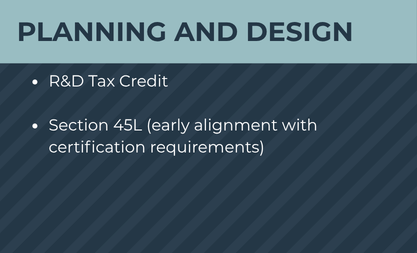
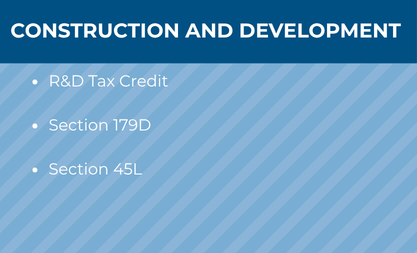
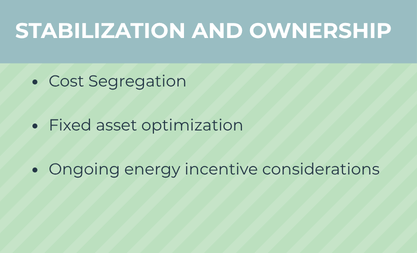
REAL ESTATE TAX CREDITS & INCENTIVES SERVICES

R&D Tax Credit
Provides a tax credit for qualifying design, engineering and construction activities that involve technical problem‑solving and innovation. In real estate environments, this credit often captures overlooked value tied to design iteration, value engineering and project-specific challenges.
Read More on R&D Tax Credit Consulting

Cost Segregation
Accelerates depreciation by reclassifying building components into shorter‑life assets, creating earlier tax deductions and improved cash flow. This strategy aligns tax treatment with how assets are actually used and can significantly enhance near-term project economics.
Read More on Cost Segregation Services

Section 179D
Offers a tax deduction for energy-efficient improvements to commercial and certain multi-family buildings, including HVAC, lighting and building envelope systems. This incentive rewards performance-based energy savings and can be integrated into both new construction and renovation projects.
Read More on Section 179D Consulting

Section 45L
Provides a tax credit of up to $5,000 per qualifying residential unit for energy-efficient construction that meets ENERGY STAR or DOE program standards. This unit-based incentive allows builders and developers to scale tax savings across single-family and multi-family developments.
Read More on Section 45L Tax Credit
FAQs
How do I know which tax credits apply to my real estate project?
Eligibility depends on how the project is designed, constructed and operated. Many projects qualify for more than one incentive, which is why a coordinated review is typically more effective than evaluating each credit individually.
Do these tax incentives overlap or conflict with each other?
In many cases, they can be used together. However, coordination is important to ensure the same costs or activities are not treated inconsistently across claims.
When should we evaluate these opportunities during a project?
Earlier is generally better. Some incentives, particularly those tied to energy efficiency or design decisions, benefit from planning during early project phases. Others can be evaluated after completion if sufficient documentation exists.
Is it too late to evaluate past projects?
Not necessarily. Some incentives can be applied retroactively depending on timing and available records. A review of prior projects can help identify missed opportunities.
How do these incentives impact overall tax strategy?
These incentives primarily affect the timing and amount of deductions or credits, which can improve cash flow and influence reinvestment, financing and long-term planning decisions.
REAL ESTATE TAX CREDITS & INCENTIVES INSIGHTS

Oct 08, 2024

Jun 11, 2026

FAQs on Cost Segregation, Section 179D and Section 45L
February 22, 2024
Five M&A Tax Wins from the One Big Beautiful Bill
September 16, 2025OUR REAL ESTATE ADVISORS

REAL ESTATE ASSOCIATIONS